Depositors of four rural banks in Henan province have not been able to withdraw their funds since April. Sporadic protests have been going on since May.
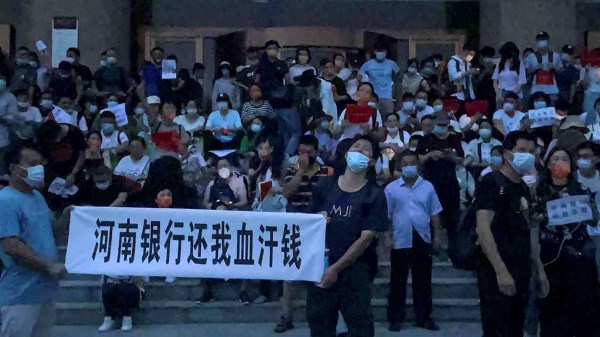
Demonstrators hold banners during a protest over the freezing of deposits by rural-based banks, outside a People's Bank of China building in Zhengzhou, Henan province, July 10, 2022. (Reuters)
In a rare large protest in China, over one thousand angry bank depositors, who have been protesting for access to their frozen funds, faced off with the police in Henan province leading to a violent clampdown Sunday.
Depositors of four rural banks in this central province have not been able to withdraw their funds since April. Sporadic protests have been going on since May.
After Sunday’s protest, China’s banking regulator announced that customers – with deposits up to 50,000 yuan – will start getting their money back beginning Friday. The arrangement to repay others is yet to be announced. What led to the cash crisis at these rural banks, and what it indicates about the Chinese economy?
What are bank runs, and why is China witnessing them?
A bank run occurs when a large number of depositors rush to simultaneously withdraw their money as they no longer consider it safe with the financial institution. Bank runs among China’s small lenders have been rising over the last few years. While Henan protests are the latest to hit the headlines, at least two small lenders had witnessed a rush for withdrawals in 2019, and five lenders were hit by bank runs in 2020, according to Reuters. In most of these cases, police had to step in to calm depositors.
In this photo released by Yang on July 10, 2022, people stage a protest at the entrance to a branch of China’s central bank in Zhengzhou in central China’s Henan Province. (AP/PTI)
China has around 4,000 rural lenders, and economists blame shrinking of economic activity amid stringent Covid curbs, opaque ownership and poor corporate governance at these institutions to have exacerbated the crisis of customer trust in Chinese financial institutions. The China Banking and Insurance Regulatory Commission (CBIRC) has been calling for consolidating assets of small lenders to defuse risks.
The protests began soon after four rural banks in Henan froze withdrawals on April 18. The frozen deposits add up to $1.5 billion, according to Chinese media reports. Initially, these banks — Yuzhou Xin Min Sheng Village Bank, Shangcai Huimin County Bank, New Oriental Country Bank of Kaifeng and Zhecheng Huanghuai Community Bank – told their customers that withdrawals had been stopped due to internal maintenance. Later, it emerged that the banks were at the centre of a financial fraud probe.
The customers of two other rural banks in neighbouring Anhui province were also impacted by the freeze.
The CBIRC has accused Henan New Fortune – a major shareholder in these rural banks – of illegally attracting money from citizens using third-party platforms.
China does not allow local banks to take deposits from customers outside their home base.
In May, the banking regulator told state-run Xinhua news agency that “Henan New Fortune Group, a shareholder of the four village banks, has illegally absorbed the public’s funds through internal and external collusion, the use of third-party platforms, and fund brokers”.
In the present case it is being alleged that these banks attracted deposits by offering attractive terms and high interest rates. A report in the South China Morning Post in May said that while Bank of China offers 2.75% a year interest on five-year deposits, the found banks in question were giving around 4.5% a year on their deposit products through third-party platforms.
Also, a statement by the Henan police on July 10 said that a criminal group had gradually taken control of several rural banks and was moving out funds.
In a rare large protest in China, over one thousand angry bank depositors, who have been protesting for access to their frozen funds, faced off with the police in Henan province leading to a violent clampdown Sunday.
Depositors of four rural banks in this central province have not been able to withdraw their funds since April. Sporadic protests have been going on since May.
After Sunday’s protest, China’s banking regulator announced that customers – with deposits up to 50,000 yuan – will start getting their money back beginning Friday. The arrangement to repay others is yet to be announced. What led to the cash crisis at these rural banks, and what it indicates about the Chinese economy?
What are bank runs, and why is China witnessing them?
A bank run occurs when a large number of depositors rush to simultaneously withdraw their money as they no longer consider it safe with the financial institution. Bank runs among China’s small lenders have been rising over the last few years. While Henan protests are the latest to hit the headlines, at least two small lenders had witnessed a rush for withdrawals in 2019, and five lenders were hit by bank runs in 2020, according to Reuters. In most of these cases, police had to step in to calm depositors.
In this photo released by Yang on July 10, 2022, people stage a protest at the entrance to a branch of China’s central bank in Zhengzhou in central China’s Henan Province. (AP/PTI)
China has around 4,000 rural lenders, and economists blame shrinking of economic activity amid stringent Covid curbs, opaque ownership and poor corporate governance at these institutions to have exacerbated the crisis of customer trust in Chinese financial institutions. The China Banking and Insurance Regulatory Commission (CBIRC) has been calling for consolidating assets of small lenders to defuse risks.
Must read |UN population report explained
Why are depositors in Henan province protesting?
Advertisement
The protests began soon after four rural banks in Henan froze withdrawals on April 18. The frozen deposits add up to $1.5 billion, according to Chinese media reports. Initially, these banks — Yuzhou Xin Min Sheng Village Bank, Shangcai Huimin County Bank, New Oriental Country Bank of Kaifeng and Zhecheng Huanghuai Community Bank – told their customers that withdrawals had been stopped due to internal maintenance. Later, it emerged that the banks were at the centre of a financial fraud probe.
The customers of two other rural banks in neighbouring Anhui province were also impacted by the freeze.
What led to the cash crisis at rural banks in Henan?
Advertisement
The CBIRC has accused Henan New Fortune – a major shareholder in these rural banks – of illegally attracting money from citizens using third-party platforms.
China does not allow local banks to take deposits from customers outside their home base.
Best of Explained
India as a 'developed' country: where we are, and the challenges ahead, explained
An Expert Explains: Why a stable Kenya is in the interest of Africa and the world
Quiet quitting: why doing less at work could be good for you – and your employer
Click here for more
In May, the banking regulator told state-run Xinhua news agency that “Henan New Fortune Group, a shareholder of the four village banks, has illegally absorbed the public’s funds through internal and external collusion, the use of third-party platforms, and fund brokers”.
In the present case it is being alleged that these banks attracted deposits by offering attractive terms and high interest rates. A report in the South China Morning Post in May said that while Bank of China offers 2.75% a year interest on five-year deposits, the found banks in question were giving around 4.5% a year on their deposit products through third-party platforms.
Also, a statement by the Henan police on July 10 said that a criminal group had gradually taken control of several rural banks and was moving out funds.
Advertisement
Also in Explained |Two years after Galwan clash, where India-China relations stand today
What does this crisis mean for China?
Anger triggered by rising bank runs could become an irritant for the government. A Bloomberg report said that a spillover into the broader Chinese banking sector was an unlikely possibility as rural banks make up a small part of the industry’s total assets. However, instability stemming from the financial system could turn into a spot of bother. President Xi Jingpins only recently underlined the importance of maintaining economic and social stability, and making citizens feel reassured on China’s road to pandemic recovery.
https://indianexpress.com/article/expla ... a-8025263/
Bank runs στην Κίνα
-
Προέλλην

- Right to Repair Champion

- Δημοσιεύσεις: 20804
Bank runs στην Κίνα

0 .
Hätt ich ne 2te Chance würd ich es genauso machen
Ich dreh mich nich um es geht nur darum wer du heute bist
Ich bin zufrieden, da scheint jemand auf mich aufzupassen
Ob es für Gott oder den Teufel is
Ich bereue nichts
Ich dreh mich nich um es geht nur darum wer du heute bist
Ich bin zufrieden, da scheint jemand auf mich aufzupassen
Ob es für Gott oder den Teufel is
Ich bereue nichts
-
Προέλλην
- Right to Repair Champion
- Δημοσιεύσεις: 20804
Re: Bank runs στην Κίνα
China’s Village Bank Collapses Could Cause Dangerous Contagion
Local problems threaten to spread into a serious crisis.
China just experienced its first wave of bank runs, triggered by frozen deposits in online accounts worth 40 billion yuan ($6 billion) and affecting 400,000 depositors. The scattered runs on small banks in central Chinese towns are not singular events but the precursor of a nationwide reshuffle of small and medium-sized banks (SMBs). Social media virality and dramatic stories of losses and protests are shaking savers’ trust in SMBs, presenting an urgent challenge to China’s banking regulators. China is fighting a war on multiple fronts against financial insecurity right now, from dubious online investment schemes to an ongoing property crisis. Preventing potential financial contagion and social unrest triggered by runs on small banks is a battle that Chinese regulators and policymakers have to win.
The recent bank runs started from three rural village and town banks (VTBs) in Henan province. Three more runs on VTBs happened within a month, including two in neighboring Anhui province. Five of the six troubled VTBs have the same major shareholder bank, Xuchang Rural Commercial Bank. Not being able to withdraw their life savings has led to protests by depositors, triggered panic over the solvency of small banks, and increased the nationwide risk of runs on small banks.
VTBs comprise 84 percent of China’s banking institutions but held just 13 percent of the total assets in the banking sector by the end of 2021. Chinese policymakers envisioned these banks as a pillar of microfinance supporting farmers and small businesses in rural China, and in 2006 they proposed pilot projects in six rural areas. Fifteen years of policy experiment has left the Chinese financial system with 1,651 VTBs that are now the most numerous entities in the banking system but individually are both small and very weak at risk management. The People’s Bank of China (PBOC), the central bank, has rated 186 rural cooperatives and 103 VTBs as the riskiest among all Chinese banking institutions. In other words, close to 7.5 percent of Chinese rural banking financial institutions are already at the highest level of risk—and the problems may go even deeper than that.
The Chinese authorities are concerned with not only the financial risks but also the potential social instability caused by the failures of VTBs and other SMBs. Chinese regulators have been seeking ways to improve the operations of small rural banks. Since 2018, they have dealt with 627 high-risk rural SMBs and disposed of nonperforming loans in the amount of 2.6 trillion yuan ($385 billion), which exceeded the total amount of the previous decade. The China Banking and Insurance Regulatory Commission (CBIRC), the Finance Ministry, and the PBOC injected 133.4 billion yuan ($19.7 billion) into 289 rural SMBs. The CBIRC has also encouraged high-quality banks, insurance companies, and other qualified institutions to participate in the mergers and restructuring of SMBs.
SMBs have become the most fragile part of the Chinese banking system. One of the key structural issues is the lack of capital replenishment channels for SMBs. They have low profitability, which makes them unable to generate replenishment capital internally. They are also unable to raise funds through external channels such as initial public offerings due to their small scale and poor credit ratings. But small banks found a natural ally as they competed with their peers for survival: online deposit platforms provided by fintech firms that were not licensed banks and thus unregulated.
These platforms, many of which made exaggerated claims about returns and some of which have turned out to be outright frauds, brought a steady stream of funds to small banks over a short period by listing deposit products online and selling them to their nationwide users. By the end of 2020, 89 Chinese commercial banks (84 SMBs) had attracted 550 billion yuan ($81 billion) worth of online deposits through such platforms, an increase of 127 percent compared with 2019. In some cases, online deposits sold to nationwide depositors even replaced interbank financing as the primary source of funds. The PBOC found that some high-risk small banks amassed 70 percent of deposits from nonlocal online deposit products sold by third-party platforms, whereas interbank financing as a percentage of total liabilities dropped from 30 percent to 3.2 percent.
In January 2021, Chinese regulators banned commercial banks from selling deposit products through third-party online platforms in a notice jointly issued by the CBIRC and the PBOC, citing concerns of increased hidden risks and the potential for financial contagion. The crackdown on online deposit products removed the life support for many SMBs with limited alternative capital replenishment sources. At that time, online deposits had reached an estimated amount of 1 trillion to 2 trillion yuan.
Although this number was a minute portion of the 90 trillion yuan ($13 trillion) in total household deposits, Chinese regulators feared the potential of financial contagion and resulting social unrest. At a press conference about the notice, Chinese officials commented that “bank deposits are the most basic form of financial services and require stricter supervision.” In the VTB context, the poverty of much of rural China means relatively small amounts can also be devastating household losses—creating a powerful motivation for the protests the authorities fear.
But there are also serious financial security concerns. The threat is not these online deposit products per se but rather the spillover impact on the increased funding costs to bankroll China’s debt-pumped economic growth. Online deposits have exacerbated the fierce competition for deposits among SMBs, directly raising their funding costs and eroding their profits. Rather than offering higher-quality financial products or better customer service, banks have thus been lowering fees and offering higher interest rates—often threatening their own financial stability as a result.
Before the crackdown in January 2021, online platforms displayed deposit products by interest rates in descending order, forcing banks to competitively raise deposit rates close to the upper limit allowed. Some banks even sweetened the deal by shortening the interest payment cycle, providing cash rewards, and issuing shopping vouchers. Apart from wooing clients, banks had to pay platforms a traffic diversion fee of about 0.2 to 0.3 percent on a monthly or quarterly basis of the average daily deposit balance on the platforms and greater fees if they wanted a more eye-catching spot. All these incentive measures raised the actual funding costs and fueled a downward spiral of competition among SMBs.
https://foreignpolicy.com/2022/07/27/ch ... contagion/
0 .
Hätt ich ne 2te Chance würd ich es genauso machen
Ich dreh mich nich um es geht nur darum wer du heute bist
Ich bin zufrieden, da scheint jemand auf mich aufzupassen
Ob es für Gott oder den Teufel is
Ich bereue nichts
Ich dreh mich nich um es geht nur darum wer du heute bist
Ich bin zufrieden, da scheint jemand auf mich aufzupassen
Ob es für Gott oder den Teufel is
Ich bereue nichts
-
vallon
- Supreme poster
- Δημοσιεύσεις: 14177
Re: Bank runs στην Κίνα
ετσι κάνουν οι σοβαρές νεοφίλ οικονομίες
τι σε προβληματίζει;
ετοιμάσου να χάσεις ότι λεφτά έχεις και σε καμιά γερμανική τράπεζα που θα πάει σε ξαφνικό θάνατο
τι σε προβληματίζει;
ετοιμάσου να χάσεις ότι λεφτά έχεις και σε καμιά γερμανική τράπεζα που θα πάει σε ξαφνικό θάνατο
0 .
Αν ο κομπλεξισμός ήταν άθλημα, κάποιοι θα είχαν πάρει πανηγυρικά το πρωτάθλημα.
-
Λαχουρένιος

- Ultimate Stalker
- Δημοσιεύσεις: 49491
- Τοποθεσία: Γεφυρα
Re: Bank runs στην Κίνα
Επιφυλλασομαι να παρω θεση μεχρι να τοποθετηθει ο κινεζος κουμπαρος του Αριστου που τα ξερει απο πρωτο χερι.
1 .
-
Perseus1966
- Extreme poster
- Δημοσιεύσεις: 2913
-
Προέλλην
- Right to Repair Champion
- Δημοσιεύσεις: 20804
Re: Bank runs στην Κίνα
Πρόκειται για επαρχιακές τράπεζες. Το σίγουρο είναι ότι όσο φρενάρει η ανάπτυξη στην Κίνα, τόσο μεγαλύτερες κοινωνικές αναταράξεις θα υπάρχουν. Μέχρι τώρα αναπτυσσόταν σταθερά με σχεδόν διψήφια νούμερα, ήταν φάση των πρώτων 15 ετών Ερντογάν, μόνο που εκεί κράτησε περισσότερο, λόγω της παγκοσμιοποίησης και της συνεισφοράς των Δυτικών.
Τώρα, σιγά-σιγά, αρχίζουν τα δύσκολα για τους Κινέζους. Κανείς Δυτικός δεν σταμάτησε ακόμη τα νταλαβέρια με την Κίνα, ούτε ακυρώθηκε η παραμικρή ήδη σχεδιασμένη επένδυση εκεί. ΑΛΛΑ, πλέον καμιά δυτική εταιρία δεν σχεδιάζει να κάνει νέες επενδύσεις εκεί, και όλοι κοιτάνε να αυξήσουν τον κύκλο εργασιών στην Δύση και την ασφαλή περιφέρειά της. Αυτό, μεσοπρόθεσμα θα έχει απρόβλεπτες συνέπειες στην Κίνα.
Η μερική αποπαγκοσμιοποίηση θα πονέσει παντού, κυρίως τον 3ο κόσμο όμως.
Τώρα, σιγά-σιγά, αρχίζουν τα δύσκολα για τους Κινέζους. Κανείς Δυτικός δεν σταμάτησε ακόμη τα νταλαβέρια με την Κίνα, ούτε ακυρώθηκε η παραμικρή ήδη σχεδιασμένη επένδυση εκεί. ΑΛΛΑ, πλέον καμιά δυτική εταιρία δεν σχεδιάζει να κάνει νέες επενδύσεις εκεί, και όλοι κοιτάνε να αυξήσουν τον κύκλο εργασιών στην Δύση και την ασφαλή περιφέρειά της. Αυτό, μεσοπρόθεσμα θα έχει απρόβλεπτες συνέπειες στην Κίνα.
Η μερική αποπαγκοσμιοποίηση θα πονέσει παντού, κυρίως τον 3ο κόσμο όμως.
0 .
Hätt ich ne 2te Chance würd ich es genauso machen
Ich dreh mich nich um es geht nur darum wer du heute bist
Ich bin zufrieden, da scheint jemand auf mich aufzupassen
Ob es für Gott oder den Teufel is
Ich bereue nichts
Ich dreh mich nich um es geht nur darum wer du heute bist
Ich bin zufrieden, da scheint jemand auf mich aufzupassen
Ob es für Gott oder den Teufel is
Ich bereue nichts
-
Προέλλην
- Right to Repair Champion
- Δημοσιεύσεις: 20804
Re: Bank runs στην Κίνα
Huawei founder sparks alarm in China with warning of ‘painful’ next decade
Ren Zhengfei writes in leaked memo that ‘chill will be felt by everyone’ and company must focus on survival
https://www.theguardian.com/technology/ ... gfei-china
Πάει η ναυαρχίδα με λίγες αμερικανικές κυρώσεις

Πέρυσι τον Σεπτέμβρη έλεγαν τέτοια μεγαλόσχημα

Huawei can prosper despite US sanctions, says board member
https://www.theguardian.com/technology/ ... ard-member
0 .
Hätt ich ne 2te Chance würd ich es genauso machen
Ich dreh mich nich um es geht nur darum wer du heute bist
Ich bin zufrieden, da scheint jemand auf mich aufzupassen
Ob es für Gott oder den Teufel is
Ich bereue nichts
Ich dreh mich nich um es geht nur darum wer du heute bist
Ich bin zufrieden, da scheint jemand auf mich aufzupassen
Ob es für Gott oder den Teufel is
Ich bereue nichts