Η βάση ξεκίνησε για πρώτη φορά το 1966 και η πρώτη ρουκέτα που εξοκετύθηκε ήταν η arcas της ΝΑΣΑ. Οι συνολικές εκτοξεύσεις ήταν 22.
American sounding rocket. The Arcas (All-Purpose Rocket for Collecting Atmospheric Soundings) was developed by the Atlantic Research Corporation for the Office of Naval Research (ONR) with the support of the Navy Bureau of Aeronautics and the Air Force Cambridge Research Laboratories. Primarily a meteorological rocket, the Arcas was first fired in July 1959. The single-stage version was designed to lift 5.4 kg to 64 km. For more demanding missions, several versions of boosted Arcas were developed, as well as a stretched Super Arcas motor.
Status: Retired 1991. First Launch: 1958-11-04. Last Launch: 1975-09-26. Number: 1442 . Payload: 4.50 kg (9.90 lb). Thrust: 1.50 kN (336 lbf). Gross mass: 34 kg (76 lb). Height: 2.30 m (7.50 ft). Diameter: 0.11 m (0.36 ft). Span: 0.33 m (1.08 ft). Apogee: 52 km (32 mi).
The Arcas was originally conceived by the Stanford Research Institute for the US Civil Defense Administration for measurement of nuclear fallout. Instead the Office of Naval Research and Air Force Cambridge Research Laboratory contracted Atlantic Research to develop the rocket to measure winds aloft prior to high-altitude aircraft or missile tests. The small missile could be loaded by two crew into a simple launch tube. This was closed, like a gun tube, the gases from the missile ensuring that it already exited the tube at 240 kph. The breech-closure and plastic spacers fell away from the rocket after it cleared the tube. The slow-burning motor worked for 30 seconds before burning out. After 75 to 100 seconds a timer jettisoned the payload nose cone, which came down under parachute and provided temperature and pressure data. Radar tracking provided altitude and wind information to correlate with this. Later payloads included falling spheres (tracked by radar to precisely measure drag), ozone measurements, and small biological experiments.
By the early 1960's as many as 42 a week were being fired in the Air Force Meteorological Network alone. Many derivatives were built, until the basic meteorological profiling task was taken over by the even cheaper Super Loki in the late 1960's.
The AN/DMQ-9 rocketsonde payload was an expendable meteorological instrument package designed for use with the Arcas rocket to obtain vertical profiles of temperature and winds in the upper atmosphere between 24 km and 60 km altitude. The instrument consisted of a transponder compatible with the AN/GMD-2 Rawin Set ground equipment. The AN/DMQ-9 upgraded the earlier design and provided improved flight performance and ease of handling in the field. Flight tests Cape Canaveral indicated that the instrument package was suitable for field use when the Rawin Set was supplemented with a parametric amplifier.
From NASA SOUNDING ROCKETS, 1958-1968 - A Historical Summary, NASA SP-4401, 1971, by William R. Corliss
During 1965 Goddard began using the Arcas sounding rocket, a vehicle first used back in 1958 by the Navy and in 1959 by Langley Research Center and Wallops. The Arcas was an inexpensive rocket, costing only about $2000 per round. Perhaps 2000 were fired each year, mainly for meteorological purposes. It was also a good rocket for launching small payloads to moderate altitudes- 5.4 kg (12 lb) to 64 km (40 mi), nominal performance, and employed no special launch equipment. It was therefore eminently suited for NASA's international programs. The Arcas was put into service in Norway, New Zealand, and other countries during the 1965-1968 period. The rockets were purchased directly from the Atlantic Research Corp.
Payload: 4.50 kg (9.90 lb) to a 52 km altitude.
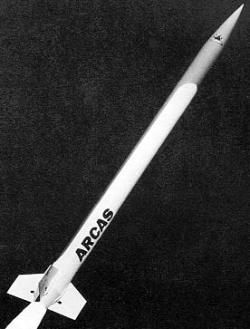
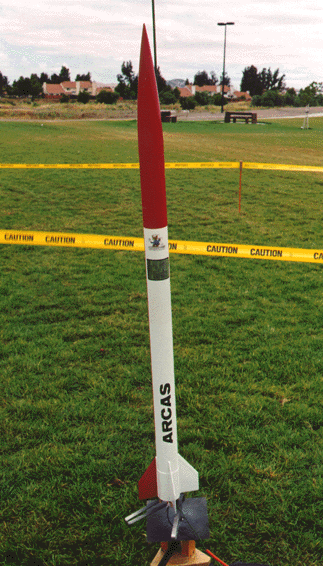

http://www.astronautix.com/a/arcas.html
Στην συνέχεια είχαμε 9 εκτοξεύσεις Sparrow Arcas της ευρωπαϊκής εταιρίας τηλεπικοινωνιών ESRO
http://www.astronautix.com/e/esro.html
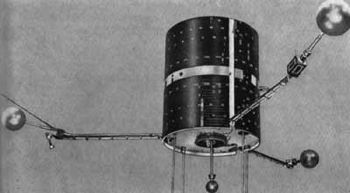
European technology satellite. The ESRO series were small Scout-launched probes of near-earth space. Research satellite built by Laboratoire Central de Telecommunications for ESRO, Europe. Launched 1968 - 1969.
AKA: Aurorae;Boreas;IRIS. Status: Operational 1967. First Launch: 1967-05-30. Last Launch: 1972-11-22. Number: 5 . Gross mass: 85 kg (187 lb).
American sounding rocket. Two stage vehicle.
Status: Retired 1971. First Launch: 1963-10-01. Last Launch: 1971-07-28. Number: 31 . Payload: 5.50 kg (12.10 lb). Thrust: 35.00 kN (7,868 lbf). Gross mass: 94 kg (207 lb). Height: 3.84 m (12.59 ft). Diameter: 0.20 m (0.65 ft). Span: 0.81 m (2.67 ft). Apogee: 175 km (108 mi).
The HV Arcas was a modification of the basic Arcas with larger fins for use at high altitude and a modified aft section to mate with the interstage to the first stage. The rocket was launched from a 4.6 m rail and their was a six second coast after Sparrow burnout before Arcas ignited. Canted fins provide both stages a roll of 8 to 15 rpm for stability. The rocket was originally designed to measure air density over the Pacific Missile Range, and later used by the military for study of the mesosphere and ionosphere.
Payload: 5.50 kg (12.10 lb) to a 175 km altitude.
Στην συνέχεια πραγματοποιήθηκε 1 εκτόξευση της Centaure 1 του γαλλικού ηχητικού πυραύλου, ο οποίος συμπεριλαμβάνεται στην οικογένεια των Belier πυραύλων.
French sounding rocket.
Status: Retired 1977. First Launch: 1963-06-12. Last Launch: 1977-12-16. Number: 115 . Gross mass: 600 kg (1,320 lb). Height: 5.90 m (19.30 ft). Diameter: 0.28 m (0.91 ft). Apogee: 130 km (80 mi).
2 stage vehicle consisting of 1 x Venus + 1 x Belier.
http://www.astronautix.com/c/centaure1.html
http://www.astronautix.com/b/belier.html
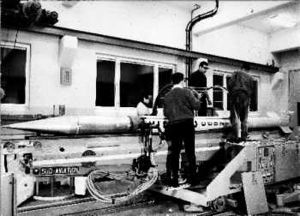
Family of sounding rockets, developed by Sud Aviation, with the only or upper stage being variants of the Belier stage powered by a Jericho rocket motor. These were the most significant series of French civilian suborbital rockets. Manufacturing licenses were sold to India and Pakistan, becoming the basis of their rocket industries.
Status: Retired 1986. First Launch: 1961-05-24. Last Launch: 1970-11-06. Number: 18 . Gross mass: 400 kg (880 lb). Height: 3.80 m (12.40 ft). Diameter: 0.31 m (1.01 ft). Apogee: 109 km (67 mi).
Sud Aviation's solid propellant sounding rockets, developed for CNET (Centre National d'Etudes des Telecommunications), used rocket motors developed for France's cancelled surface-to-air missile programs of the 1950's. An improved version of the Jericho 1 motor, originally developed as the sustainer stage of the MATRA R422 missile, was used for the single stage Belier rocket. The rocket was spin stabilised by small solid rocket engines on the four fins.
Το 1972 η βάση παραδόθηκε στην Σοβιετική Ένωση για επιστημονικά πειράματα και εκτοξεύσεις ρουκετών. Οι πύραυλοι είχαν κινητήρες Μ-100 ήταν κυρίως περισσότερο για επιστημονική έρευνα παρά για πραγματική εκτόξευση μετεωρολογικών δορυφόρων, διότι κουβαλούσαν φορτίο μέχρι 15κιλά. Στην Κορώνη πραγματοποιήθηκαν 359 εκτοξεύσεις των Σοβιετικών με μέγιστο επιτεύξιμο ύψος στα 114 χμ.
http://www.astronautix.com/k/koroni.html
http://www.astronautix.com/m/m-100.html
M-100
Two-stage, solid propellant, fin stabilized, unguided Russian sounding rocket, fired in greater numbers than any other. At least 6,640 of all models were fired to the edge of space before the vehicle was discontinued in 1990. 4,908 of the basic M-100 model were fired from 1957-07-11 to 1983-09-28.
Status: Retired 1993. First Launch: 1957-07-11. Last Launch: 1986-12-01. Number: 5888 . Payload: 15 kg (33 lb). Gross mass: 475 kg (1,047 lb). Height: 8.34 m (27.36 ft). Diameter: 0.25 m (0.82 ft). Span: 0.66 m (2.18 ft). Apogee: 90 km (55 mi).
The M-100 is said to have begun testing in 1953, using propellant with a specific impulse of only 150 seconds. The rocket was used to make basic weather soundings on a world-wide basis. A typical flight consists of launch to 90 km altitude, following by the descent of the nosecone under a parachute over a period of 50 minutes. During the descent the payload radioed temperature, pressure, and density data. Below 50 km radar could be used to track the nose cone and determine winds aloft. In the 1970's the M-100B was cross calibrated by firing it simultaneously with American Super Loki-Dart, British Skua, and French Super-Arcas rockets. This allowed it to be integrated into the World Meteorological Rocket Network.
While the M-100 has been equipped with non-standard payloads, it was used in such numbers over such a long period that the data from the series was used to determine long-term climate trends (a steady drop in temperature of 0.3 to 1.0 deg C per year at an altitude of 80 km).
When the Soviet Union collapse, funding for state scientific work evaporated. Launches of the M-100 abruptly ended.
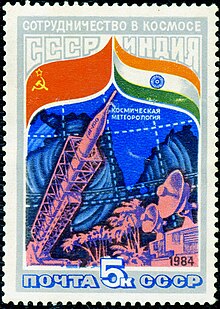
Εδώ ένα γραμματόσημο της τότε εποχής.