In 1979, Aleksandr entered the Moscow Aviation Institute. He was expelled without a degree either because of low academic achievement, dissident activities or both. Afterwards, he began working as a street cleaner. He used a forged reader's card to access the Lenin Library and continue studying. However, other sources claim he instead started working in a KGB archive, where he had access to banned literature on Masonry, fascism and paganism.
In 1980, Dugin joined the "
Yuzhinsky circle [ru]", an avant-garde dissident group which dabbled in
Satanism, esoteric Nazism and other forms of the occult. In the group, he was known for his embrace of Nazism which he attributes to a rebellion against his Soviet raising, as opposed to genuine sympathy for Hitler. H
e adopted an alter ego with the name of "Hans Sievers", a reference to Wolfram Sievers, a Nazi researcher of the paranormal.
Studying by himself, he learned to speak Italian, German, French, English and Spanish. He was influenced by René Guénon and by the Traditionalist School. In the V. I. Lenin State Library he discovered the writings of Julius Evola, whose book Pagan Imperialism he translated into Russian.
In the 1980s, Dugin was a dissident and an anti-communist. Dugin worked as a journalist before becoming involved in politics just before the fall of communism. In 1988,
he and his friend Geydar Dzhemal joined the ultranationalist and anti-Semitic group Pamyat/[b](Memory), which would later give rise to Russian fascism. For a brief period at the beginning of the 1990s he was close to Gennady Zyuganov, leader of the newly formed Communist Party of the Russian Federation, and probably had a role in formulating its nationalist communist ideology. In 1993 [b]he co-founded, together with Eduard Limonov, the National Bolshevik Party, whose nationalistic interpretation of Bolshevism was based on the ideas of Ernst Niekisch. He left the party in 1998 following disputes with Limonov.
Dugin disapproves of liberalism and the West, particularly US hegemony. He asserts: "We are on the side of Stalin and the Soviet Union". He describes himself as being a conservative: "We, conservatives, want a strong, solid state, want order and healthy family, positive values, the reinforcing of the importance of religion and the Church in society". He adds: "We want patriotic radio, TV, patriotic experts, patriotic clubs. We want the media that expresses national interests".
According to political scientist Marlène Laruelle,
the thinking of Dugin, main manufacturer of a fascism à-la-russe, could be described as a series of concentric circles, with far-right ideologies underpinned by different political and philosophical traditions (Esoteric Nazism, Traditionalism/Perennialism, the German Conservative Revolution and the European New Right) at its backbone.
Dugin adapts Martin Heidegger's thought of Dasein (Existence) and transforms it into a geo–philosophical concept. According to Dugin, the forces of liberal and capitalist Western civilization represent what the ancient Greeks called ὕβρις (hubris), "the essential form of titanism" (the anti-ideal form), which opposes Heaven ("the ideal form—in terms of space, time, being"). In other words, the West would summarize "the revolt of the Earth against Heaven". To what he calls the West's "atomizing" universalism, Dugin contrasts an apophatic universalism, expressed in the political idea of "empire". Values of democracy, human rights and individualism are considered by him not to be universal but uniquely Western.
https://en.wikipedia.org/wiki/Aleksandr_Dugin

.gif "Teleia")



 σικέ δημοψήφισμα
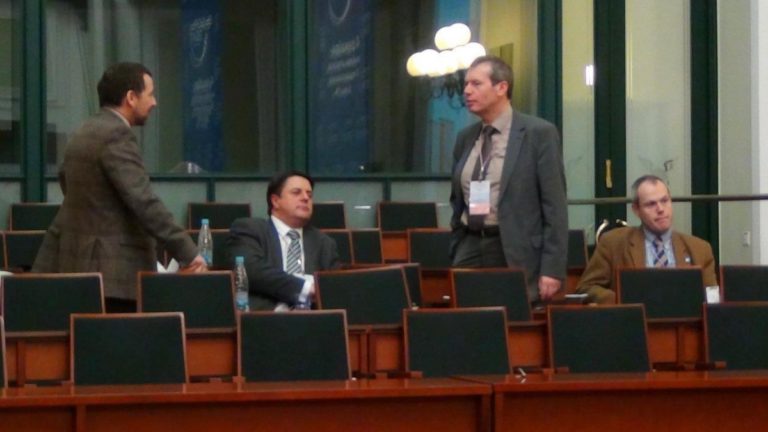
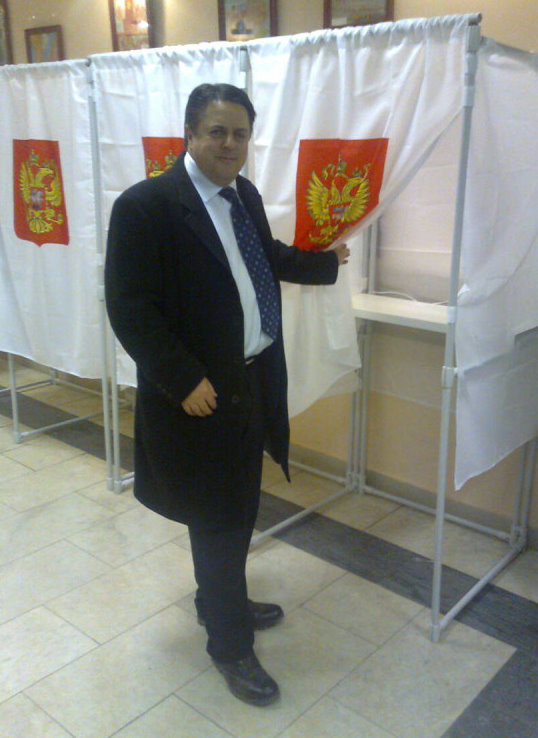
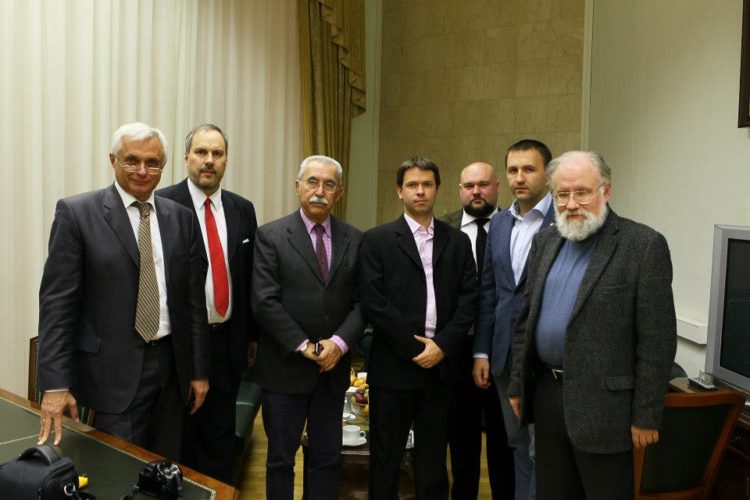
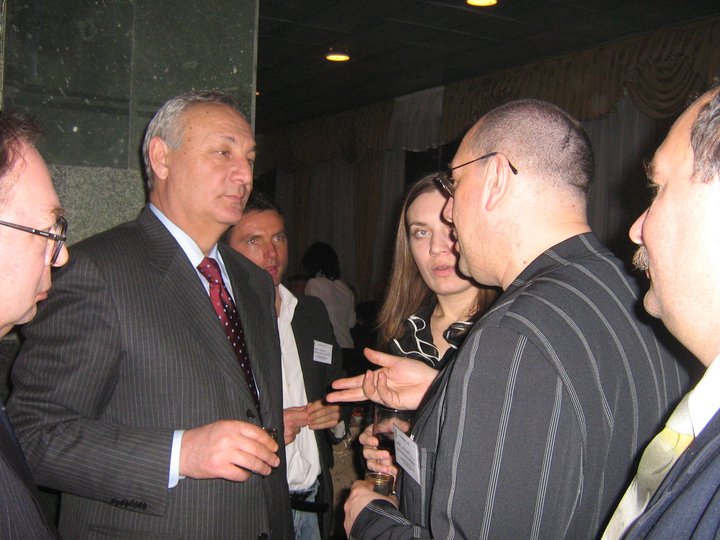
.gif "Laughing") , and the EODE’s Fabrice Beaur (fourth from the right). The man on the far right is Vladimir Churov, Chairman of Russia’s Central Election Commission notorious for electoral fraud.
, and the EODE’s Fabrice Beaur (fourth from the right). The man on the far right is Vladimir Churov, Chairman of Russia’s Central Election Commission notorious for electoral fraud.